Former USA bronze medalist at the 1976 Olympics, “Big John” Tate captured the vacant WBA Heavyweight title by defeating South African Gerrie Coetzee in front of nearly 90,000 fans in Pretoria on October 20, 1979.
Five months later, on March 31, 1980, his first defense took place in his adopted hometown of Knoxville, Tennessee, against Mike Weaver. On paper, it didn’t appear to be a herculean task. Tate sported an impressive 20–0 record (with 16 knockouts) after besting top-tier contenders. Weaver, an ex-marine, came in with a lackluster 21–9 record and a slow career start.
However, Weaver had something Tate didn’t: championship experience. Less than a year earlier, he had pushed WBC Heavyweight Champion Larry Holmes to the brink before being stopped in the 12th round.
With veteran announcer Keith Jackson calling the fight for ABC, the Stokely Athletic Center was packed with 13,000 spectators. Weaver weighed in at 207½ pounds with a 78-inch reach. Tate was an imposing 6’4”, holding advantages in both reach (80”) and weight (232 pounds).
The Early Chess Match
The first five rounds largely belonged to Tate. Dictating the pace with his left jab and overhand rights, he peppered Weaver’s head and body. Yet, Weaver absorbed the punishment with patience, pacing himself for a long night.
By the fifth round, a cut over Tate’s eye proved Weaver was landing counters of his own. As the fight wore on through the middle frames, Tate remained ahead on the scorecards, bullying Weaver with combinations and working inside. But as Jackson noted by the 11th round, time was running out for the challenger: “At this juncture, the only hope Mike Weaver would have would be to nail the big guy.”
Championship Rounds and a Glimmer of Life
The final four rounds are where this heavyweight tilt turned legendary.
In the 12th, after being tagged with an overhand right, Weaver fired back with a solid left hook that landed smack on Tate’s jaw, backing the champion up for the first time all night. For the next two minutes, Weaver chased a wobbly Tate all over the ring, swinging wildly as the crowd roared the “Big John” chants to help their fighter survive the round.
Tate shook off the cobwebs by round 13, trying to box from a distance. But in the 14th, Weaver pressed forward aggressively—though a second low blow cost him a crucial point on the judges’ scorecards.
Then came the 15th round. Do or die time for Mike Weaver.
The Knockout Heard ‘Round Knoxville
Both fighters were exhausted, but Weaver’s sheer desperation drove him forward. With just under a minute remaining, Weaver forced Tate into the corner and trapped him.
A right to the midsection made Tate lurch forward. Then, seemingly out of nowhere, Weaver landed another right to the body followed by a wicked left hook that clocked Tate squarely on the jaw.
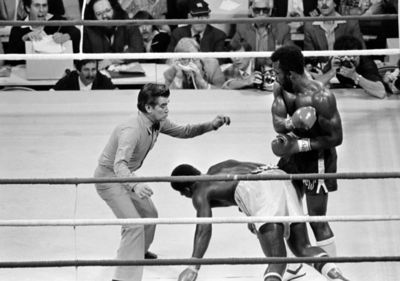
The big man leaned to the side, tumbling face-first onto the canvas. As Weaver celebrated with a backflip, referee Ernesto Magana and Tate’s cornermen rolled the conscious champion onto his back. It was a stunning end to Tate’s short reign. If he had simply listened to his corner and continued to have kept Weaver at a distance, the defense would have been in the bag—he was ahead on all three judges’ scorecards.
Postscript: The Tragic Aftermath
After that stunning loss, Big John Tate never fought for a heavyweight title again. Three months later, a knockout loss to Trevor Berbick at just 25 years old essentially broke him.
By 1984, plagued by a divorce, money troubles, and a botched comeback attempt, Tate’s career derailed entirely. In a 1988 interview before his final bout against Noel Quarless, Tate admitted to blowing $300,000 to $400,000 on drugs in the early ’80s, which stripped away everything he earned in the ring. Prison time for petty theft and assault followed.
Tragically, in April 1998, Tate’s life ended abruptly at age 43 when he crashed his pickup truck into a utility pole just a mile from an old training camp. While toxicology reports later indicated heavy cocaine use at the time of the accident, it was a sorrowful end for a man whose career never reached its full potential.
Yet, for five brief months in 1979–1980, Big John Tate achieved what very few ever do. He reached the absolute pinnacle of the sport and was a heavyweight champion of the world.


Leave a Reply