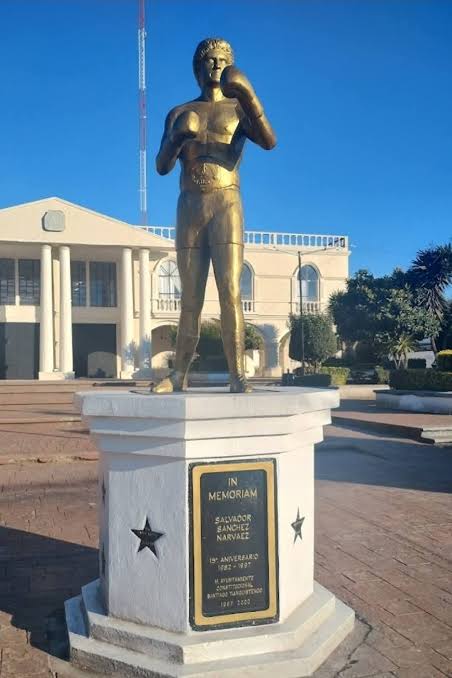
Salvador Sanchez Narvaez was born in the small town of Santiago Tianguistenco, Mexico, located not far from the state capital of Toluca. He was one of eleven children and, by all accounts, came from a modest family. He wasn’t poor, and there was always food on the table at home. The story goes that he was introduced to boxing when a local fighter in Mexico City brought him to a gym and set up his first professional fight in 1975, when Sanchez was just 16 years old. While it wasn’t much, he reportedly earned 2,000 pesos for that first bout. He broke his nose but knocked his opponent out in the 3rd round of their 4-round fight.
This set him on a path that would see him honing his skills and fighting all over Mexico over the next two years. By the time he fought a boxer named Antonio Becerra in 1977 for the vacant Mexican Bantamweight title, Sanchez’s record stood at an impressive 18-0. Although he lost a split decision—which would be the only loss Sanchez suffered in a career totaling 46 fights—it didn’t slow him down. While Becerra’s career ultimately stalled, Sanchez dusted himself off and went on to become one of the greatest champions ever to come out of Mexico.
Ascent
Moving up to Featherweight, there would be one more taste of adversity and a minor setback in Sanchez’s young career before he went on an impressive run toward a title fight. In his first fight in the US on April 15, 1978, in Los Angeles, Sanchez fought to a draw with Juan Escobar. This fight marked the only time in his career that Sanchez was knocked down, sent to the canvas in the 5th round. This was new territory for the young Sanchez, yet from that point on, he won 13 straight fights over the next two years.
That streak set him up for his first-ever title shot on February 2, 1980, in Phoenix, Arizona, where he met veteran Danny “Little Red” Lopez, holder of the WBC Featherweight title.
Fighting for The Title – A National Hero
By the time the 21-year-old Sanchez stepped into the ring to fight Lopez, he was already an extremely accomplished fighter with a record of 33-1-1. Lopez was no slouch either. His record coming into the fight stood at 42-3, and since taking the title from David Kotei in Ghana at the end of 1976, he had successfully defended it eight times.
It had all the makings of a classic, but it quickly became apparent in the early rounds that although Lopez had the heart of a lion and could take a punch, he was no match for the superior Sanchez. The young fighter picked him apart mercilessly with a sharp left jab and quick combinations. Although Lopez was a notoriously slow starter, his strategy was to be the aggressor: cut off the ring, pin opponents on the ropes, and work both the body and head with combinations. However, he was never able to employ this tactic against Sanchez, who stayed off the ropes using superior side-to-side movement and an ability to fight effectively from a distance. As a result, Sanchez was never an easy target.
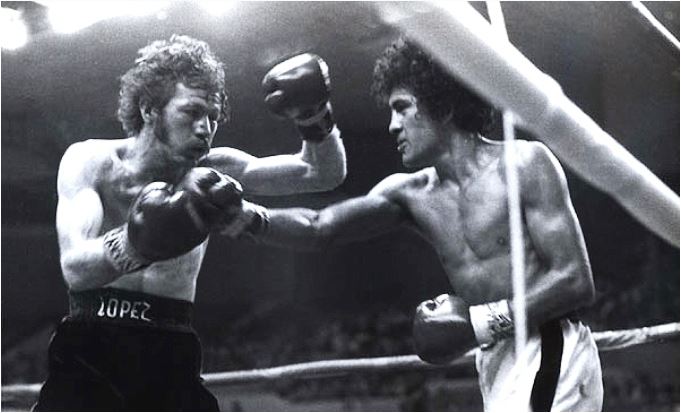
After a successful title defense two months later against Ruben Castillo, the stage was set for a rematch against Lopez on June 21, 1980, in Las Vegas. The fight was practically a carbon copy of their first meeting. Although Lopez fared slightly better in the second fight, it was clear he hadn’t done enough. Lopez tried to apply pressure, but Sanchez’s superior movement once again kept him elusive, often making Lopez miss and punishing him with precise counterpunches. Lopez made it to the 14th round, but Sanchez tagged him with a combination that buckled his knees. As Sanchez went in for the finish, referee Mills Lane stepped between them and stopped the fight. Danny Lopez was a gutsy fighter with knockout power who could absorb punishment with the best of them, but in the end, Sanchez’s stamina and superior ring smarts were too much. Lopez announced his retirement after the fight, though he returned for one fight twelve years later at age 40, only to be knocked out in the 2nd round.
The Champion’s Road Is Paved With Gold
After effectively ending Danny Lopez’s career, Sanchez went on to make three consecutive title defenses against Pat Ford, future champion Juan Laporte, and Roberto Castanon, before briefly stepping up to Super Featherweight to defeat Nicky Perez in a unanimous decision.
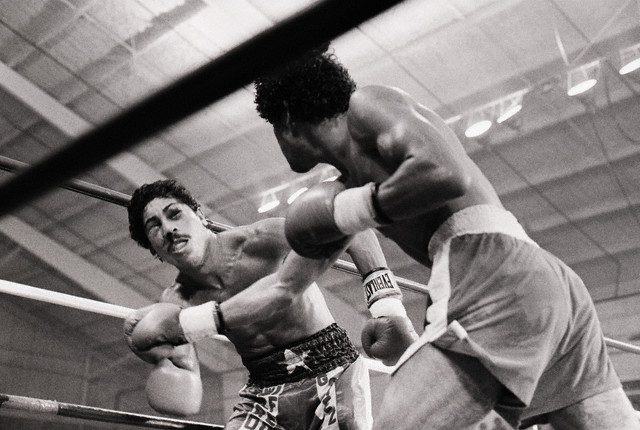
However, it was his next fight in the summer of 1981 that everyone wanted to see. Wilfredo Gomez, the unbeaten Puerto Rican star who had ruled the Super Bantamweight division as WBC Champion for four years, moved up to challenge for Sanchez’s title. Gomez entered the ring with an incredible streak of 33 consecutive knockouts. Billed as “The Battle of the Little Giants,” Gomez tried to come out as the aggressor in the first round, but Sanchez quickly reset his expectations with a combination that swiftly sent him to the canvas. After Gomez got up, Sanchez unleashed a constant barrage, though he was ultimately unable to put him away immediately. Gomez barely survived the round, but the damage was done.
By the 6th round, Gomez could barely see out of both eyes—reduced to swollen slits—yet he continued to battle like the warrior he was. Knowing time was of the essence, Gomez knew that if he didn’t finish Sanchez off quickly, his face wouldn’t hold up. In the 8th round, both fighters went toe-to-toe trading blows. Gomez was fighting off the ropes when Sanchez tagged him with a flurry that sent him to the canvas once more. Although he stood up, referee Carlos Padilla had seen enough and stopped the fight at 2:09 of the 8th round. Some suggested the extra weight hindered Gomez’s chances that night, but the truth was simple: he was beaten by the better fighter. Salvador Sanchez was in peak physical condition, executing his game plan with clinical precision. Though the fight had been competitive on the scorecards—with all three judges favoring Sanchez by just a couple of points—the stoppage was decisive.
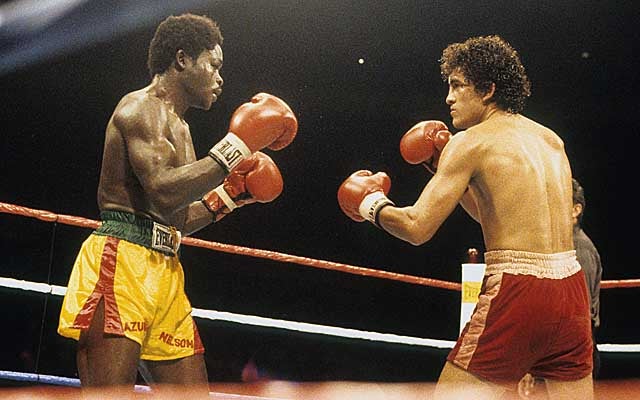
Salvador Sanchez would fight three more times, with his final appearance coming on July 21, 1982, at the famed Madison Square Garden in New York City against future champion Azumah Nelson. Nelson was 13-0 at the time, but because most of his fights had taken place in Africa, he was largely unknown in the United States. He took the fight on just two weeks notice, giving Sanchez’s camp equal time to figure out what kind of fighter Nelson was. It was a thrilling, competitive bout, with Nelson demonstrating the heart of a future champion. Sanchez sent him to the canvas for the first time in the 7th round and for a second and final time in the 15th round, prompting the referee to stop the fight at 1:47.
An Unexpected Ending
As early as high school, Salvador Sanchez had harbored dreams of becoming a doctor. Now at the height of his fame, he spoke open-heartedly about retiring at the end of 1983 to go back to school to practice medicine. He wanted to retire as champion, but first, he desired one last landmark fight against Alexis Arguello. Moving up to challenge Arguello for his WBC Lightweight title would be a bold move and negotiations between the two camps were actively underway in the hopes of a fight later that year.
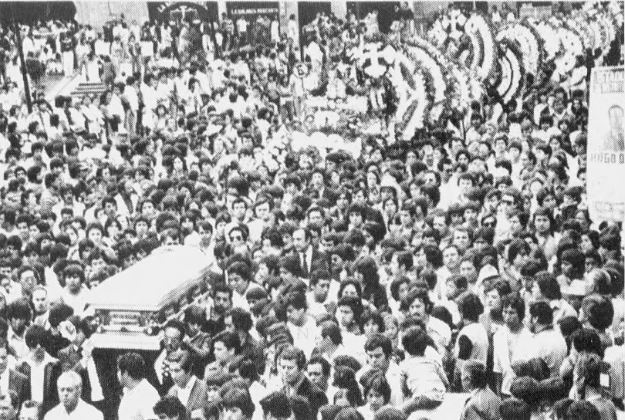
Then, on the morning of August 12, everything changed. Just three weeks after his victory against Azumah Nelson, in the early morning hours, Salvador was involved in a high-speed, three-vehicle collision when his Porsche 928 rear-ended a transport truck on the highway between Querétaro and San Luis Potosí, Mexico. He was killed instantly, depriving the sport of boxing of one of its most distinguished young champions. He was buried in his hometown on August 14th and left behind a 21-year-old bride and two young sons.
I believe that Salvador Sanchez’s legacy should be that he goes down as one of the all time great Featherweight fighters of his generation. Sure there will be critics who might question the level of his opponents outside his high profile, tougher fights against the likes of Lopez and Gomez or that his reign of two years as a champion was not nearly long enough to put him in the conversation with the all time greats. It’s difficult to judge when he was robbed of any future opportunities to prove himself, and remember even if he had continued boxing, this was a fighter who was only 23, had not even reached his prime and look what he was able to accomplish.


Leave a Reply