
I watched so many fights on television beginning around 1980, and it seemed like every weekend there was at least one main event in any given weight class happening. I was 12 years old when I began to really catch the boxing bug. In all the fights I watched in the early to mid-80s, I really had no idea how many boxers in history that had suffered severe injuries and/or died in the ring or in the days or weeks following a fight. There are two that distinctly stand out. One was a fighter by the name of Cleveland Denny, who was fighting on the undercard of the Sugar Ray Leonard/Roberto Durán spectacle at Montreal’s Olympic Stadium on June 20, 1980, and the other was a South Korean lightweight named Duk-koo Kim, who fought Ray “Boom Boom” Mancini in a championship bout in Las Vegas on November 13, 1982. Both of their deaths were shrouded in controversy and in this two-part series, we’ll examine the details on how these two fighters met their untimely endings- starting with Cleveland Denny.
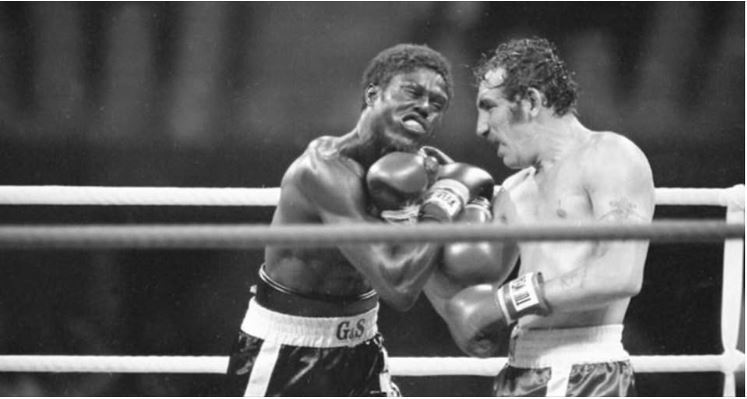
Cleveland Denny, who’s story is largely unknown outside of the city of Montréal and the province of Quebec, was fighting on the undercard of the Roberto Durán–Sugar Ray Leonard main event in Montréal in the summer of 1980. Denny was born in Guyana but was based in Montréal and had turned pro in 1976. Competing as a lightweight, he came into the fight against his opponent, another boxer from Quebec by the name of Gaétan Hart, with a respectable record of 10-1-1. In fact, both fighters knew each other quite well, having fought previously on two occasions. Denny got the better of Hart in their first meeting, winning a unanimous decision in 1977, while Hart won the rematch a year later to take the Canadian Lightweight title off Denny.
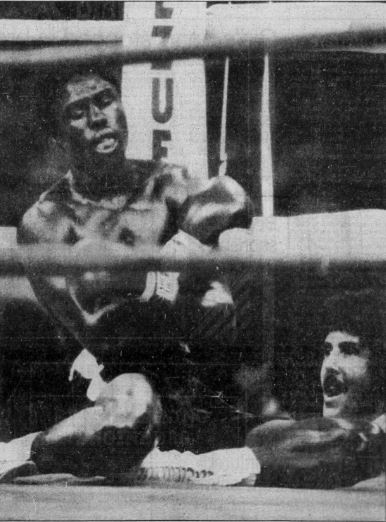
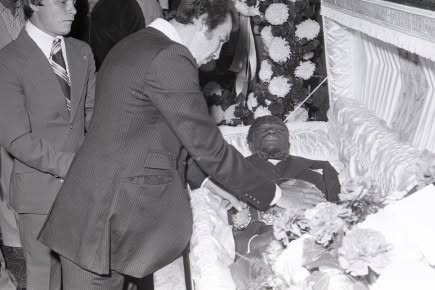
The event wasn’t broadcast live and was only available via closed-circuit television (the precursor to modern-day pay-per-view), and when it was broadcast over a week later on ABC TV, only the main event between Leonard and Durán was shown during their 90-minute broadcast. Why this is significant is because the bill got off to a rather disheartening start as Hart knocked Denny out with only seconds left in the 10th and final round of their non-title fight. Because their fight was a domestic Canadian bout, there is no full-length video of their showdown that night. Suffice it to say, this may have actually been a good thing, because in that 10th round, Hart caught Denny with a hard right that staggered him and then proceeded to dish out a savage beating of six straight punches before Denny slumped to the canvas in one corner of the ring—his head tilted slightly to one side, eyes closed, with his arms folded out across his chest and his mouth open. I didn’t see this fight live, but I did see this image on the front page of the local newspaper the following morning, and that image stayed with me for a long time, I can tell you that. It took them 10 minutes after the end of the fight to get Cleveland out of the ring and on a stretcher, largely because Dr. Ferdie (“The Fight Doctor”) Pacheco called his condition “very serious. His eyes were dilating and we couldn’t get his mouthpiece out. I told them, get him to the hospital right away.” Denny was transferred to a local hospital, and even though doctors attempted to reduce the swelling on his brain, he never regained consciousness. His family took him off life support 17 days later. Cleveland Denny was just 24 years old and left behind a wife and a 5-month-old son.
Aftermath and Questions
Other than perhaps the question of whether or not referee Rosario Baillargeon could have stepped in earlier to end the beating, there wasn’t much to scrutinize—that is, until it was reported that in Hart’s previous fight just over a month earlier, he had also sent his opponent, Ralph Racine, into a coma in the 12th and final round of their title fight, which also took place in Montréal. Fortunately, Racine would come out of his coma, and although his life would never be the same again, at least he was alive. The odds that a fighter could beat an opponent into a coma even once in their career were slim, to say the least, but to do it in two consecutive fights? Well, that was damn near astronomical and definitely raised some eyebrows. Gaétan Hart wasn’t even considered to be a power puncher, and in fact, coming into the fight with Denny, only 22 of his 46 wins had come via knockout.
So what was one to make of this eerie coincidence? In an excellent, extensive exposé written by Canadian sports writer Earl McRae at the end of 1980, it was suggested that there were possibly other circumstances that may have contributed to these savage outcomes. The exposé’s main focus centered around the very specific way of how a boxer’s hands are wrapped before a fight. A combination of gauze and tape is used, and there are specific rules on not only how the fighter’s hands are wrapped, but also how many feet of gauze and tape are permitted. When McRae questioned both Hart’s and Denny’s trainers on how much of each was used, the numbers weren’t right, which pointed to clear violations, especially regarding Hart’s hands.
Why does this matter, one may ask? Well, the purpose of tape is to protect the boxer’s hands. Simple enough. However, when the question of what the effects might be if a fighter has too much tape on his hands is posed to Syd Martin, an experienced trainer of 50 years, the answer is: “Too much tape becomes like plaster of Paris, so the hands become heavier as the fight wears on and the punch becomes a lot harder. Eight-ounce gloves can become 12 ounces.” It appeared that Hart had over four times the legal amount of tape on each hand. Questions in the exposé were also raised about the inspection process, which appears to have been lackluster at best. Before each fight, inspectors do just that: they inspect how the trainers tape, ask questions if necessary, and then initial the tape once done to verify it has been checked. The problem that night is the inspector was not present during the actual taping; he only appeared to sign off on the finished product. In the ring at the end of the fight, one of Denny’s handlers, who preferred to remain anonymous for the article, said that when Hart came over to check on Denny, he reached out his ungloved hand to shake the handler’s hand, and he said he was shocked at how hard it was: “I’ve been in the game for years. It definitely wasn’t right.” The hand wrapping violation wasn’t the only systemic failure that was exposed in the wake of the fight. There were preventative measures that were missed which could have helped prevent the tragedy in the ring that night.
The fact is that at that time in Canada, boxing was sanctioned by various different commissions under the federation. However, the federation had little to no jurisdiction over various provincial and municipal commissions. Fights could take place in areas that weren’t under a particular commission, thus exposing fighters to unnecessary risks. Most importantly, there was no central database to accurately track a boxer’s fighting record, meaning a log of who fought when and where. Records could be doctored or falsified at will.
Missed Warning Signs
Before that June 20 fight, MAC (Montréal Athletic Commission) rules were such that before a fight, boxers only needed to have a routine medical exam. A few days after the Denny/Hart fight, that rule was amended by the commission to include both an EEG (electroencephalogram) and an ECG (electrocardiogram). However, an EEG would not be able to detect abnormalities in the brain such as a blood clot, which is exactly what doctors found when they tried to reduce the swelling on Denny’s brain. A CAT scan would have detected this, and in fact, Denny had been scheduled to get one after being hurt in training during sparring. However, the hospital couldn’t fit him in for that CAT scan before the fight. Had he had the scan, he might not have died in the ring that night. They couldn’t say for certain whether or not the clot the doctors saw when he was admitted to the hospital had been caused by Hart’s punches or if it had been there before. Hart’s manager Andy Nadon threw another wrench into the mystery by suggesting that Denny had a bump on his leg going into the fight, which could have resulted in the clot.
Postscript
In the end, we’ll never know exactly what caused Cleveland Denny’s death. He took a savage beating in the ring, something boxers risk every time they fight. Given what we do know, it appears his death might have been preventable had certain checks not been missed.
A year later, Cleveland’s widow, Clarine Peters, filed a lawsuit for $509,682 that named Hart, his trainer, the MAC, and the Olympic Installations Board, claiming that proper steps weren’t taken to ensure both fighters met the weight restrictions. It also mentioned that Hart’s bandages had been wrapped in the absence of a member of the athletic commission, which was a clear violation. There was no further recorded mention of the lawsuit after that initial filing, so one is left to assume that it was settled out of court.
In what seemed like a final piece of cruel irony, Cleveland Denny’s accidental death insurance payout of $25K was larger than his reported purse ($18K) for fighting Hart.
In Part 2 we’ll take a deep dive into the 1982 tragedy of Duk-koo Kim.


Leave a Reply